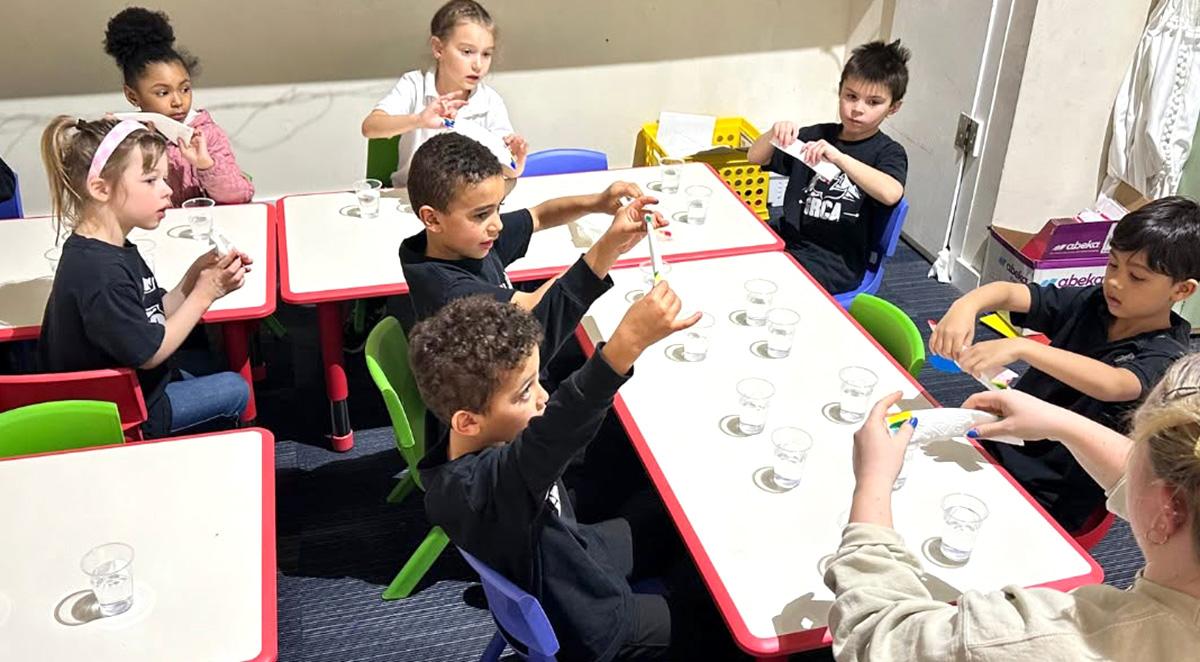
Now that the school year is underway, a lot of parents are quietly taking stock. They're watching how their child settles in, how much attention they seem to get, and whether they're truly known by their teachers. If you've found yourself wondering whether a smaller classroom would make a difference, you're asking one of the most studied questions in education.
The short answer is that class size matters, though not always for the reasons people assume. It's less about the number itself and more about what a smaller group makes possible. This post looks at what the research says, why smaller classes tend to help, and how that plays out day to day at Great Rock Christian Academy.
Quick Summary
- Decades of research, including the landmark Project STAR study, link smaller early-grade classes with stronger reading and math achievement.
- The real advantage isn't the number on the roster; it's the individualized attention, engagement, and early support a smaller group allows.
- Smaller settings make it easier to catch learning struggles early, before small gaps become large ones.
- Knowing students well lets teachers challenge advanced learners and support those who need more, at the same time.
- Class size is one ingredient among several, and it works best alongside strong teachers and a healthy school culture.
- At Great Rock, a smaller school means teachers know each student by name and learning style and can teach responsively.
What the Research Actually Says
The most influential study on this question is Project STAR, a large randomized experiment run in Tennessee in the late 1980s. It followed more than 7,000 students across 79 schools, randomly assigning them, along with their teachers, to smaller or larger classes from kindergarten through third grade. That random assignment is what makes its conclusions unusually trustworthy.
The headline finding was straightforward. Students in the smaller classes scored significantly higher in reading and math than their peers in larger ones. Follow-up research known as the Lasting Benefits Study found those advantages persisted into later grades.
Project STAR isn't the only evidence, either. When several states reduced class sizes in the primary grades, and when researchers examined similar efforts in other countries, the pattern of early-grade gains tended to reappear, especially for younger students and those with the most ground to make up.
It's worth being honest that the topic isn't fully settled. Some researchers have questioned how consistently the STAR results replicate and whether large-scale class-size reduction is always cost-effective. What holds up well, though, is the set of reasons smaller classes tend to help, and that's where the practical story lives.
Individualized Attention and Engagement
In a smaller class, a teacher simply has more of themselves to go around. With fewer students, they can give more attention to each child and individualize their instruction. Some students get extra support, others get a deeper challenge, often within the same lesson.
Engagement rises, too. With fewer students in the room, each child has more chances to contribute to discussions, ask questions, and interact with the teacher rather than hang back. Those small, repeated moments of participation build both understanding and confidence over time.
There's a common misconception that individualized attention means lowering the bar. In practice the opposite tends to be true, since teachers who know their students well are better able to challenge them appropriately. Advanced learners get enrichment, and students who need more get targeted help.
Catching Struggles Early
One of the quietest but most important benefits of a smaller class is early intervention. When teachers can devote more time to individual attention, they're able to identify learning problems precisely and early, before a student falls behind.
That timing matters enormously. A reading stumble caught in first grade is far easier to address than the same gap discovered in fourth. Smaller groups give teachers both the visibility to notice a problem and the time to respond to it.
Academic and Social-Emotional Outcomes
The benefits aren't only academic. In a setting where a child feels known, belonging comes more easily, and students who feel they belong tend to engage more and worry less.
Stronger teacher-student relationships are a big part of this. When a teacher understands how a particular child learns, feedback becomes faster and more useful, and the child comes to trust that their effort will be noticed. Learning tends to accelerate when that feedback arrives while a lesson is still fresh.
There's a quieter social benefit as well. In a smaller group, it's harder for a shy or struggling child to disappear into the back of the room, so more students stay connected to the class and to one another. Confidence often grows from exactly those repeated, low-stakes chances to be part of things.
What Class Size Can and Can't Do
For all the evidence in its favor, class size is only one ingredient. A small class taught by a distracted or underprepared teacher won't outperform a larger class led by a gifted one. The number on its own guarantees nothing.
What the research really shows is that smaller classes make good teaching easier to deliver. Paired with strong teachers, a thoughtful curriculum, and a supportive culture, a smaller setting lets all of those strengths reach each student more fully. That's the honest framing: small class size is an amplifier, not a substitute, for quality.
Small by Design, Not by Limitation
It's easy to think of a small school as simply a shrunken version of a big one, but that misreads the picture. Intentionally small schools trade breadth in some areas for depth in relationships and attention.
That's a genuine trade-off, and it's worth naming honestly. Rather than trying to replicate the scale of a large school, smaller schools can offer something different: deeper relationships, greater familiarity between teachers and students, and a close-knit community. For many families, that exchange is exactly the point.
How This Plays Out at Great Rock Christian Academy
At Great Rock, being a smaller school isn't a footnote; it shapes the whole experience. Teachers here know their students by name and by learning style, which means instruction can flex to the child in front of them rather than to an average.
That responsiveness can look ordinary from the outside, but it adds up. A teacher notices when a normally chatty student goes quiet, remembers which concept a child found tricky last week, and adjusts the next day accordingly. It's exactly the kind of attention this body of research points to as the real engine behind smaller settings. You can meet the people who do this work on the Our People page.
For families whose children have unique learning needs, Great Rock's Student Support Department partners with parents to help students grow. GRCA does not provide the same special education services available through a public school, so families with specific learning needs are encouraged to speak with us directly about the support GRCA is able to provide. That candor is part of how the school earns trust with families from the very first visit.
None of this depends on a particular number on a class roster. It depends on a culture where knowing students well is treated as the foundation of good teaching, woven together with daily chapel, a Christ-centered mission, and a genuinely close community. You can see how that fits into the wider program on the academics overview page.
Frequently Asked Questions
Do smaller classes really improve academic performance?
Research, including the well-known Project STAR study, links smaller early-grade classes with stronger achievement in reading and math. The mechanisms behind that, mainly individualized attention and engagement, are well supported even where scholars still debate the exact size of the effect.
Isn't a bigger school better for opportunities?
Larger schools often offer more programs, and that can matter for some families. A smaller school trades some of that breadth for depth of relationships, closer attention, and a stronger sense of belonging, which many families find more valuable for their child's daily growth.
What if my child needs extra help?
Smaller settings make it easier for teachers to notice a struggle early and respond before it grows. At Great Rock, the Student Support Department also works with families whose children have particular learning needs, though formal special education services are limited.
How can I tell if a school's classrooms are the right fit?
The best way is to see them in action. Watching how teachers interact with students, and how students respond, tells you far more than any statistic on a brochure.
The Bottom Line
Smaller classes help not because of a magic number, but because of what a smaller group makes possible: attention, engagement, early support, and relationships that let teachers meet each child where they are. That's the difference parents are really after when they wonder whether their child is being seen.
If you'd like to know what that feels like in person, we'd love to show you. Schedule a tour to meet our teachers and see our classrooms firsthand, and to picture your child as part of the community.