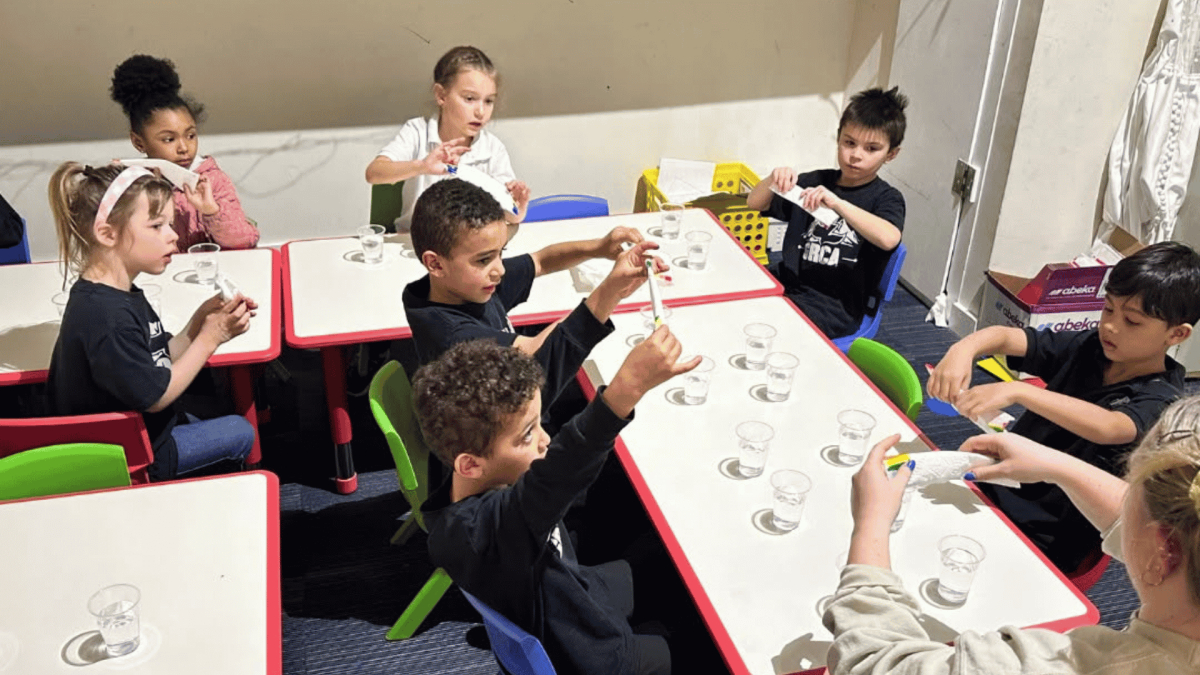
For a growing number of Massachusetts families, the choice is no longer simply "homeschool" or "enroll in a school." A third path has opened up, one that lets parents keep the parts of homeschooling they love while adding the structure, community, and expert instruction that can be hard to recreate at the kitchen table. That path is the homeschool co-op, and it is quietly reshaping how families think about education on the North Shore.
If you have never heard the term, or you have heard it but were not sure how it actually works day to day, this guide is for you. We will walk through what a hybrid homeschool model looks like in practice, how it differs from full-time enrollment, who is responsible for what, and why so many families are drawn to it.
Quick Summary
- A homeschool co-op lets families combine at-home learning with part-time classroom instruction at a school.
- The school provides teaching, community, and structure in specific subjects.
- The model appeals to families who want flexibility without giving up peer connection, academic support, or a shared faith environment.
- At Great Rock Christian Academy, co-op students receive the same instruction as full-time students and become full members of the community.
- Middle and high school families can build a schedule as light as three days per week, depending on course selection.
What a Homeschool Co-Op Actually Is
At its simplest, a homeschool co-op is a cooperative arrangement where homeschooling families share teaching responsibilities or tap into outside instruction. Traditional co-ops are often run by groups of parents who take turns leading subjects. In recent years, a more structured version has emerged: the school-based hybrid co-op, where a homeschool family enrolls their child in specific classes at an established school.
This school-based model gives families access to teachers, real classrooms, lab equipment, and a peer group, without committing to full-time enrollment. Your child might attend school for math, science, and English while you continue to guide history at home. The result is a blend that many parents describe as the best of both worlds.
The key distinction is flexibility with support. You are not handing your child's entire education over to an institution, and you are not going it alone either. You are building a partnership.
Co-Op vs. Traditional Full-Time Enrollment
The difference between a co-op and full-time enrollment comes down to who directs the education and how much time the student spends on campus.
In full-time enrollment, the school takes primary responsibility for the student's academic program. The child attends every school day, follows the school's full curriculum, and the school handles record-keeping, assessment, and compliance.
In a homeschool co-op, the family remains the primary educator. The student attends only for the classes the family chooses, and the parents retain responsibility for the overall educational plan and for meeting their district's homeschooling requirements. What does not change is the quality of instruction the student receives in the classes they do attend. In a well-run hybrid program, a co-op student sits in the same class, with the same teacher, learning the same material as a full-time student.
That last point matters. Some families worry that "part-time" means "second tier." In a strong program, it does not. The co-op student's experience in the classroom is identical to everyone else's.
Who Does What: Home vs. School
One of the most common questions parents ask is simply, "What am I still responsible for?" It is a fair question, because the answer shapes your daily life.
Here is how responsibilities typically divide in a hybrid model:
- The family handles: registering as homeschoolers with the local school district, maintaining the primary home curriculum, submitting any documentation the district requires such as work samples, progress reports, or testing, and directing the overall educational plan.
- The school handles: instruction in the enrolled subjects, classroom management, grading for those courses, and providing a structured, supervised learning environment.
Massachusetts has specific homeschooling regulations, and each district administers them a little differently. Families remain responsible for knowing and meeting their own district's requirements. The school can teach your child algebra, but it cannot file your homeschool paperwork for you. Understanding this division upfront prevents surprises later.
Why the Hybrid Model Appeals to Massachusetts Families
The hybrid co-op has grown in popularity for reasons that go well beyond convenience. Families are drawn to it because it solves several problems at once.
Flexibility without isolation.
The most frequently cited drawback of homeschooling is social connection. A co-op gives children a genuine peer group, classroom friendships, and group learning experiences while parents keep control of the schedule and curriculum.
Academic support in demanding subjects.
As students move into the upper grades, subjects like advanced math, lab sciences, and formal writing become harder to teach at home. A co-op lets families lean on experienced teachers exactly where they want the help.
Values alignment.
For families who homeschool partly to protect a particular set of values, a faith-based co-op reinforces rather than competes with what is taught at home. The worldview stays consistent from the kitchen table to the classroom.
A gradual on-ramp.
For families new to homeschooling, or families considering a move away from their current school, the co-op offers a lower-stakes way to test the waters without an all-or-nothing decision.
How the Homeschool Co-Op Works at Great Rock Christian Academy
At Great Rock Christian Academy, the homeschool co-op is built around a simple idea: meet families where they are. Some come to us wanting help in one or two subjects. Others want their child in the classroom community most of the week. Both are welcome.
The Enrollment Pathway
Families who choose the co-op enroll through our homeschool enrollment pathway. Students in this pathway receive the same instructional program and the same course offerings as our traditionally enrolled students. There is no separate, watered-down track. Your child learns alongside full-time students, taught by the same teachers.
Families remain responsible for registering with their local school district as homeschoolers and for submitting any documentation their district requires under Massachusetts homeschool regulations. We are glad to talk through how this works, but the district relationship stays with the family.
Part-Time Attendance Options
Attendance flexibility depends on your child's grade level. For middle and high school students, core subjects meet three days per week. If classes are chosen strategically, with no more than two core subjects, a student could attend as few as three days per week. For elementary students, subjects meet daily, and while our co-op is designed to work with homeschool families, we are not able to accommodate customized weekly schedules at the elementary level.
We are always happy to sit down and map out what a realistic schedule might look like for your family and your goals.
The Same Instruction, the Same Community
Co-op students are not visitors at GRCA. They participate in daily chapel, eat lunch with classmates, and build the same friendships full-time students do. Our teachers invest in every child in the room, and co-op families become part of the wider school community, connecting with other parents and sharing the journey.
Individual courses are available through the co-op at an accessible per-course rate. You can find current details on our Tuition and Fees page.
Frequently Asked Questions
Can my child attend only a few days per week?
For middle and high school students, core subjects meet three days per week, so a carefully chosen schedule of no more than two core subjects can allow attendance as few as three days weekly. For elementary students, subjects meet daily, and we are not able to build customized weekly schedules at that level. We recommend reaching out so we can discuss what fits your family.
What is the difference between private enrollment and the homeschool co-op?
There is no difference in the education your child receives. Both pathways offer the same instruction and classroom experience. The main distinction relates to athletics: students enrolled through the homeschool pathway may be eligible to participate in their town's public-school athletic programs, while privately enrolled students may not. Eligibility is determined by your local district and the governing athletic association, and families are responsible for confirming it.
Will my child receive a transcript?
Yes. Great Rock Christian Academy is able to issue a valid transcript at the end of the school year for the courses your child completes with us.
Is Great Rock an accredited school?
Great Rock Christian Academy is recognized by the Town of Danvers as a private school and is in its early years as an institution. We are not yet accredited, which is common for newer schools, since accreditation is a multi-year process that requires an established track record of student work and assessment data. We are committed to pursuing accreditation as the school matures, and we are always happy to talk through what this means for your family.
Ready to Explore the Co-Op?
The beauty of the hybrid model is that it bends to fit your family rather than asking your family to bend to fit it. Whether you want expert help in a single subject or a near-full classroom experience with the flexibility to travel, teach, and lead at home, the co-op can be shaped around your goals.
Every family's homeschool journey is different, and the best next step is a conversation. To request a Homeschool Program information packet and learn how the co-op could work for your child, contact our admissions team. We would love to hear your story and help you find the right path.